Monday, May 24, 2010

Rebuilding a Library


Two summers ago our downtown completely flooded. It was on the news all over the world. I got emails from France. It was a surreal week. The most memorable part was putting all our furniture up on conference tables and packing essentials for a stay at a friend's house. Just as we were locking up the Iowa National Guard pulled up in a Humvee and told us to get out. We were spared, but our public library wasn't. The entire adult collection was lost (the kid's books were on a second story).

I felt like I had lost personal property. See, I spent years reading all the woodworking books at our library, so I felt like they belonged to me in a way. Not as a personal possession, but more like a connection that one feels with a favorite teacher. My woodworking teacher, I'll call him Mr. Taunton, was gone. I had cut my woodworking teeth on old back issues of Fine Woodworking, hardbound in 9 volumes and dubbed the "Techniques" series. I couldn't check those out again. They were covered in muddy foetid sludge, mildew ridden, soggy. They were literally garbage.

As our city plans to rebuild and replenish the Library, I felt a bit information-starved, even though I don't check books out too often anymore. Don't get me wrong, the Internet can be a wonderful place for information, but wading through the muck and sludge to get to good information can sometimes take a lot out of a person. Much like trudging through a flooded library in search of a spared volume. After helping some friends clean up after the flood, I can say that its not much fun.

So it was with particular interest one day earlier this spring that I found a local Craig's List ad for a complete set of Fine Woodworking back issues, all the way through to April 2010. The owner said he was only missing perhaps 10 issues. Asking price? $100.

I jumped on the phone. And here's how the conversation went:

Ring.....

Hello?

"Good morning, I saw your ad on Craig's List and was wondering if you still have the magazines"
(it was about 4pm, so I figured someone had already snagged them)

"Well, I just placed the ad this morning, you're the first person to call"

"Oh, really? Great! Where can I see them?"

"I'm cleaning out some old things in my office right now and have the magazines out, stop by now if you'd like"

"Okay, I just off work, I'll head over now. What's the address?"
(at this point I could have sworn I recognized the man's voice)

--He gives me the address--

"Say, what's your name?"

"Jim"

"Smith?"

"Yeah"

"Jim! It's Jameel."

And we both had a good laugh. It turns out that Jim mows the neighbor's lawn and Jim has snuck a peek into my shop over the years. Finally, last year he stopped by with one of these:


It's a Shepherd smoothing plane kit that Jim had built at a Galootapalooza event a few years ago. We had a fun afternoon talking tools and getting the kit finished. Jim had never prepared the iron.

So I headed over to Jim's straightway and picked up the magazines. And here's the touching part. Jim has subscribed to Fine Woodworking since issue 1. So I feel especially honored to be "inheriting" this collection from Jim.

So until our library gets rebuilt (they have already begun), my own personal library will be more than adequate to suffice.

Oh, one more bonus came with Jim's collection. Several years of American Woodworker (the good ones when Ellis Walentine, Andy Rae, Ian Kirby and others were in charge) and several recent years (and a few older ones--anybody need plans for an "Alien On A Swing"?)of Popular Woodworking magazine, which is now chock full of great content (my back issues are stacked right alongside my FWW issues). Some may lament the recent loss of Popular Woodworking's ad-free spin-off Woodworking Magazine, but when there are no ads, you miss out on great content like this way back from the pre-Internet days:

Sunday, March 21, 2010

Tour of the Aquila Strings Factory

My best selling oud strings are Aquila, made my Mimmo Peruffo and company at Aquila Corde Armoniche in Vicenza in Northern Italy. The Italians know a thing or two about making strings for musical instruments. As you'll hear in the video, most of the strings you buy, whether they be LaBella, D'Adarrio, Pirastro, originated in the same town in Italy. Also note the historical string engravings and plates from past centuries. Neat!

Mimmo also makes gut strings. I do not sell these, since they are quite expensive. But they are, without question, the best-sounding strings I've ever used. If you've never tried gut strings before, I suggest you try out a set.


In this video Mimmo shows the process for making Nylgut, the synthetic gut strings that Aquila is famous for.


Here Mimmo shows the beginning steps of how real gut strings are made.

Sunday, March 14, 2010

Oh, You Speak French? Oui.

Well, actually I don't speak French. But I really like French woodworking. I work on a couple French workbenches almost daily. I stumbled on these videos today. These videos remind me of the great period of 18th c. woodworking in France. Andres Roubo, Thomas Jefferson, Ben Franklin. I bet things have changed very little with some of these techniques since these folks were tooling around Paris.

Note: Blogger doesn't scale the videos properly. Double click them to see the entire frame.

Marquetry and Veneer work.


Straw Marquetry


Gunstock work


Wood clogs. This man's family has been making them continuously since 1734.


More here: http://www.vanishingtrades.eu/

Sunday, February 28, 2010

A collaborative effort--Shaker Bench


Last year I got a call from Ron Brese of Brese Plane. He wanted to discuss a new bench for his woodworking shop, and incorporate Benchcrafted vises into it. Over the past few months Ron designed his new Shaker-style bench and built the red painted cabinet base pictured above. At Ron's generous invitation, I went down to Thomaston, GA for the last phase of construction; building the top and installing the vises.


After almost a week of long nights, Ron and I got the bench about 90% finished. As I mentioned in an earlier post a couple weeks ago, watching Ron at work was a real pleasure. It's not often you get to see an accomplished tool maker use his own tools to construct a piece of furniture.

Christopher Schwarz says in his excellent book Workbenches... that the Shaker bench has an "indescribable appeal". The legacy of the Shaker craftsmen seem to be expressed in this bench design more than any other bench style. Continental benches (trestle base, overhanging top) are too ubiquitous to carry such an aura. English benches are rather plain and never gained the widespread popularity of the Continental style. How many modern-day bench makers offer an English-style bench? Maybe it's because so few Shaker benches still exist, or ever existed (due to the short span of that community) that this feeling has developed. Perhaps its also that Shaker benches are maybe the only truly American style bench.

In The Workbench Book (Taunton) author Scott Landis writes about the distinctive feature of the massive Shaker bench at Hancock Village:

"The order and cleanliness provided by the enclosed base cabinet had many practical dividends for the workbench. The problems of racking and sliding, which are inherent in an open-frame base, are automatically resolved by the rigidity of the casework and the sheer weight of its structure. Loaded with tools, as it presumably was, the cabinet anchored the whole bench to the floor and to move it would have taken a small army."


The cabinet on Ron's bench is as rigid as any Roubo base I've seen, including the several I've built.

Ron comments:

"My former bench included an enclosed case for the base and this works well in my limited space. For me this is sort of the ultimate version of that style bench. Seeing the famous workbench that resides at the Hancock Shaker Village in person verified to me that this was the bench that I wanted to build. The advantage to this style construction is that it really simplifies the build of the top and I like the look of the top made of 3 wider boards as compared to a lamination of several 8/4 thicknesses. Having a stout cabinet to support the 2" thick top really makes this possible. Besides the wonderful work holding capability of this bench I visually enjoy the contrast of the red base to the natural color of the maple top. I was quite lucky in that the maple that I purchased for this project possessed a nice honey to medium brown color. This bench is the first thing I see when I walk in my shop everyday, standing at the ready to assist me with my work."


A recent J-style smoothing plane perched on top of Ron's new bench.

There are some aspects to the Shaker bench that prevent options for every workholding situation. The most significant is the ability to use holdfasts in the top, since the cabinet below would interfere with the shaft. There are ways around this. See the Lee Valley Hold Down with short shaft. Ron's top overhangs the base by several inches all around, and provides ample clamping opportunities. Ease of construction is also a plus of this bench design. The top is 2" throughout, with a front section at 4-1/4" containing the dog holes and vises. The cabinet base, with its several solid, vertical dividers provides lots of support for the top. The back of cabinet is finished with lapped solid pine boards.


An interesting note about Ron's Glide Leg Vise. He opted to install the roller brackets on the inside of the cabinet's end, making the vise hardware completely invisible from the outside. A handy access panel at the end of the base cabinet allows ready access to the guts of the vise. Ron reports his innovative arrangement works as smooth as silk.

I'll never give up my Roubo, but as a second bench I am seriously considering building a Brese-Shaker style bench. I enjoy the open base of my Roubo for storing bench appliances, but the cabinet base of Ron's bench offers oodles of storage, and that's something that any shop can use more of. Plus, I'll readily admit it (I take pride in being a practical woodworker, perhaps falsely so), who would not be inspired by having a bench like Ron's greet you whenever you head to the shop.

Ron and I shot some video during the build. This is an HD video. To get the full experience, click on the "full screen" icon in the bottom right, then make sure "HD ON" is selected (bottom right) once the window fills the screen.


Brese Plane Shaker-Style Bench Video, Part One


Brese Plane Shaker-Style Bench Video, Part Two

Tuesday, January 12, 2010

Traditional Woodowork in the Balkans


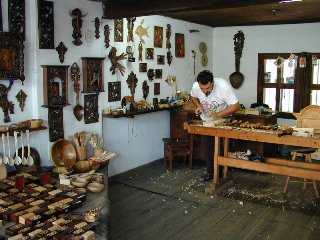
In Northern Greece there is a large peninsula that has served as the home to spiritual aspirants for over a millennium. Life on Mt. Athos (named for the peak at the eastern end of the peninsula) has remained largely unchanged since its founding in the 10th century. Greek Orthodox monks live a life of prayer and fasting, and when not engaged in prayer or worship, occupy themselves with everything from incense-making and sewing, to carving and turning wood. These items are sold in order to buy the necessities of life that can't be produced by the monks themselves. Since many of us woodworkers tend to spend large amounts of time in solitude in our shops, I'm reminded of the disciplined life of these monks whenever I'm alone in the shop. Their accomplishments go largely unnoticed though (and rightly so), as their works are left unsigned and thus anonymous. When works are signed, they are prefaced with the phrase "by the hand of..." thus showing that the work is accomplished by the grace of God, through the hand of the worker.

The following video which shows one such shop on Athos. Much like many of the pre-electric European and American shops, this is one is powered by a water wheel and leather belting. Later in the video we see a monk who specialized in miniature carving. Some of these ornate crosses take years to finish. We also see a human-powered olive oil mill.


Although not a monastic setting, the ethnographic museum "Etar" in Gabrovo, Bulgaria shares some similarities with the small shops of Athos. I visited this working museum in 2000. It's much like Colonial Williamsburg. The entire village runs off water power, harnessing that resource to drive lathes, mills and various other machines, as well as provide places for washing clothes. The shops along the main street of the village offer everything from carved spoons and boxes to fine metalware, glassware and jewelry, all executed using 18th-century methods. The artisans are not simply reenacting life two hundred years ago, they are actual craftsman producing quality work that you can purchase.


Wednesday, December 9, 2009

Brese Panel, Bench discoveries


I've been building a trio of small Shaker end tables with my niece and nephew over the past few months. Sadly, they don't have an industrial arts or woodworking program at their school, so I though it would be a good idea to give them some shop time and get their feet wet in some old-school woodworking, the kind that I was exposed to growing up. It's hard to compete with Call of Duty and Ipods, but I think these sessions will plant a seed and hopefully blossom at a later time when the lures of youth start to fade. During the past couple sessions (I'm building a table too to walk them through the process) I've found myself reaching for a plane that I've been babysitting since early October.


Ron Brese's latest creation is a stainless steel panel-size plane with an atypical infill. It doesn't really have an infill at all. I first saw this type of arrangement while browsing through some old plane patents, and later when I read an article about the Sindelar Tool Museum which featured joined-body planes with lever-caps and separate totes and knobs. Ron's plane echoes the classic lines of the old Norris planes, with its sidewall profile and traditional lever cap. The panel plane always interested me, mostly because I didn't know what it was used for. Is it a smoother? a Jack? Well, it's basically telling me what it is in using it the past couple months. I'm finding myself using it to remove jointer and planer marks on smaller workpieces where I can flatten and smooth without changing tools. I just take a couple more strokes (my shavings are about 2 thou).


The ergonomics of the tool are great. I think the sidewalls are a tad too high (this is a prototype after all), but Ron's tote's always fit my hand perfectly. I also greatly prefer the front knob to a the square bun arrangement typical of infills. There's one feature I discovered right away that I really like. See the curve in the top of the steel frog where it transitions from the inside of the side wall to the side of the tote?


This area is perfectly for my index finger. It's almost like the plane was made for my hand. I feel like I'm in total control when I place my finger here. It's great. More info later as I continue to have fun with my "loaner".


Last month I took a Sunday afternoon and made a bench dog for every hole in the top. Why didn't I do this before? I don't have to search for a single dog anymore, plus something very nice happened. New workholding opportunities are presenting themselves. I was planing some narrow boards using Chris Schwarz's leg-vise planing stop (I love using this accessory) and I needed some lateral support. Bingo, pop up two dogs and I have restricted movement in two planes almost instantly. Love it! I can even reposition the stop so the first dog lands right at the beginning of the board, preventing any kick-out at the beginning of the stroke. Here's where I could see a real advantage to having a row of dog holes a bit farther back from the front edge for working wider boards. That's a trade-off though too. No bench is ever perfect.


Monday, November 16, 2009

Roubo Bench Mystery


I was looking at some hi-res scans of L'Art du menuisier and found an interesting element just below the top to the right of the left leg. I've never noticed this before, and am curious as to its function. If anyone has any idea what this thing is, please comment below.


Follow up: I found another instance of this object hanging on the left wall with other layout tools and gauges. This one clearly has a round hole in it and is hanging on a nail on the wall. I'm wondering now if it might be a pattern. See the item to the right, it looks like pattern for an ogee shape. This wouldn't be a layout tool, since its shape and size specific. Hmmm...